Monday, August 11, 2014

NOLA Healthcare story: Relationships before technology


 - New Orleans
 

A study of New Orleans’ Beacon Community demonstrates how community relationships are essential when introducing and sustaining technology in healthcare settings.

Researchers from the Louisiana Public Health Institute examined the Greater New Orleans area healthcare system, which required rebuilding following the Hurricane Katrina disaster. In 2010, the city received a three-year $13.5 million Beacon grant, which was called the Crescent City Beacon Community (CCBC), to demonstrate population health improvement through the use of health IT by lowering the burden of chronic disease, primarily diabetes and cardiovascular disease.

The researchers looked at how the CCBC built partnerships to transform the system, and how health IT interventions were selected by a community to improve the continuity of care and ultimately health outcomes—and well as challenges faced.

The researchers identified the following health IT implementation efforts that should be prioritized:

  • Adapting a conceptual framework;
  • Building community partnerships;
  • Creating a governance infrastructure of stakeholders, particularly with those who have a history of working together; and
  • Developing a "learning community" to share best practices and guidelines.

“Building and developing community partnerships takes time and effort; however, these relationships are necessary and essential to introducing and sustaining new technologies in a healthcare setting and should be a first step for any organization looking to accomplish such goals,” concluded the authors.

Real value of supplies for strong financial projections in Healthcare

Healthcare systems have used value analysis since the late 80s, but the process is gaining more prominence amid the uncertainty created by healthcare reforms and other changes in the way hospitals are reimbursed within government sponsored organizations.

The work of assessing the value of the supplies, equipment and services a hospital needs is handled by committees made up of members of the hospital’s clinical staff and its supply chain organization. The goal must be pulling in all the key players in the organization that need to be involved in the decision.

Big hospitals may have multiple committees such as value analysis steering committee as well as a number of groups that focus on different categories of products.

A value analysis project can start with a clinical issue, such as staff unhappiness with the way a piece of equipment is performing, or with a goal to realize savings on a certain type of supplies. You might be buying products within the same family; maybe you’re buying them from six or seven vendors, but If you can get it down to one or two vendors, you aggregate the volume and you can get a better pricing.

There are big bucks involved since some of the savings realized from value analysis can relate to prevention, example on a personal assessment for oral care kits that nurses could use with patients on ventilators. While the kits were a little more expensive than purchasing the components separately, providing oral care is one of the ways to prevent ventilator-associated pneumonia, which according to some estimates can push up the cost of a patient’s stay by high values. So if you have someone getting a kit – that’s less than %40 of the actual weight on your total purchasing budget a day to per unit to prevent it – you can justify that cost.

Value analysis should consider whether clinical staff will make use of all of a product’s features, As another example of two monitors, both clinically acceptable, one of which has “a whole lot of bells and whistles. The question is, do you need the added features? And if you don’t, why are you going to buy a monitor with a whole lot of features that no one is ever going to use?

A hospital’s technological capabilities are another consideration. If your hospital is old and you don’t have the infrastructure for wireless capability, why are you buying pumps with wireless capabilities?

Price isn’t a reliable guide to quality. I frequently hear the comment from staff, Oh, you just buy the cheapest product out there; my answer to that is the cost of a product has nothing to do with the quality of a product. You can have really expensive stuff that’s really no good. And you can have inexpensive stuff that’s the workhorse and really good.

The process of assessing the value of products involves a lot of negotiation and diplomacy. However at some point, you have to have that leadership piece.

We have to understand that there are savings targets that we need to reach. It could be that you have to show a surgical department their supply cost for surgery is different than his four colleagues. Until someone sees that, they might not even know their supply cost is higher than everyone else’s.

One key to putting together strong financial projections for healthcare projects is taking time at the outset to consider the design.

Before you start modeling, there are a lot of decisions you have to make; initial considerations should include the projection’s time frame, the level of detail and the stakeholders involved.

The amount of detail depends on the project. Since with smaller projects requiring less. “If it’s a major, major expenditure, like should we buy this hospital, it probably needs to be more detailed, because the risk is higher.

The biggest challenge in putting together financial projections for hospitals is the lack of good benchmarking data. We can get benchmarking data for the hospital in total, but it’s real difficult to drill down to the service line or the department level, and that’s really where those decisions need to be made.

The uncertainty underscores the need for healthcare systems to have contingency plans or build cushions into their projections. You don’t want to be in a process where you need to hit every dollar on that forecast in order to continue functioning as a hospital. Therefore including too much detail in financial presentations to the board will help to keep focus.

Tuesday, July 15, 2014

What is an unauthorized immigrant in USA?

An unauthorized immigrant is anyone who is in the United States but doesn't have any form of legal immigration status and, therefore, no legal authorization to be here. In 2012, there were approximately 11.5 million undocumented immigrants in the United States.

Approximately half of them entered the country illegally (in most cases, by crossing the border from Mexico into the southwestern United States). The other half entered legally — on temporary visas — but didn't leave the country when the visas expired: they're known as visa overstays.

Roughly %85 of undocumented immigrants have been in the US for at least five years, and the majority have lived here for at least 10 years. The unauthorized immigration wave peaked from 1996 to 2006:

Newimmigrants2

Experts cite a number of reasons for the growth in the unauthorized population since 1996. Many believe the legal immigration system just couldn't satisfy US companies' demand for labor. Some cite poor immigration enforcement, especially at the work place, on the other hand, others say that increased border security has made people less likely to leave. And some point to a 1996 law that made it more difficult for unauthorized immigrants to receive legal status while living in the United States.

Many unauthorized immigrants in the United States have children who are native-born US citizens. An estimated 4.5 millions US-born children have at least one unauthorized parent.

Sunday, May 11, 2014

40 maps that explain the Middle East

http://www.vox.com/a/maps-explain-the-middle-east#map-1

Why EHRs are not (yet) disruptive

In 2005, Rand Corporation projected widespread use of electronic health records (EHRs) could save the U.S. $81 billion per year in health care. Eight years later, more than 80% of hospitals use EHRs and have received incentive payments for their “meaningful use,” yet projected savings have still not materialized.  Many blamed our bloated hospitals.


We disagree. EHRs are not unsuccessful because of health care providers’ ineptness. Rather, they are a potentially disruptive technology that got caught in a legacy business model that can only prioritize sustaining innovations.


What makes an innovation “disruptive”?

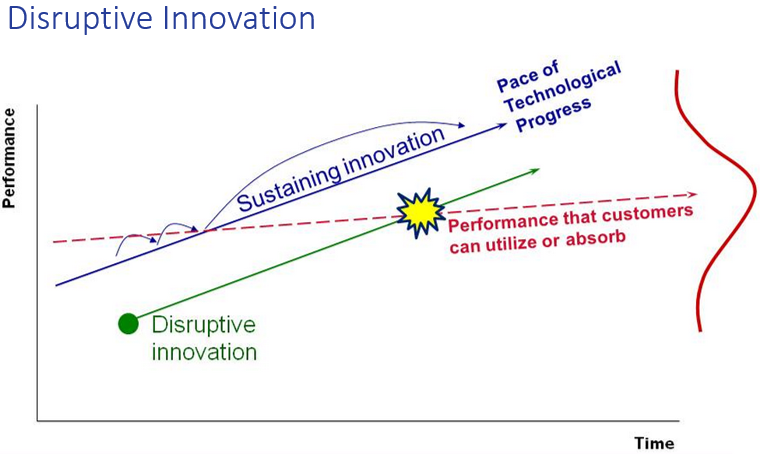
Disruption does not just mean ‘idea making waves’ or ‘breakthrough technology.’ Rather, disruptive innovation theory explains how companies with cheaper, lower performing technologies target non-consumers or low-end customer segments and grow upmarket to eventually kill larger competitors with less expensive, simpler products. The personal computer, for example, disrupted the mainframe and minicomputer industry.

 
disruptive innovation

In contrast, a sustaining innovation targets demanding, high-end customers with better performing, more complex products. Next year’s car model is a sustaining innovation. It’s sleek, has more horsepower than most of us could ever use, and costs more than last year’s model. Sustaining innovations result in wonderful, high performing products but not lower prices.


The reason EHRs are not “roiling the healthcare landscape” with disruption is not that the technology is bad—rather it’s the business model in which they are being implemented. While there is some evidence that EHRs can help to increase healthcare quality, the technology is by and large being crammed into sustaining business models and used as an expensive sustaining innovation to replace paper records with complex electronic systems.  Implementing new technology to sustain the way you already make money almost always keeps costs high and prevents true disruption. Indeed, the history of innovation is littered with companies that had a potentially disruptive technology such as EHRs within their grasp but failed to commercialize it successfully because they did not couple it with a disruptive business model.


Business model lock-in

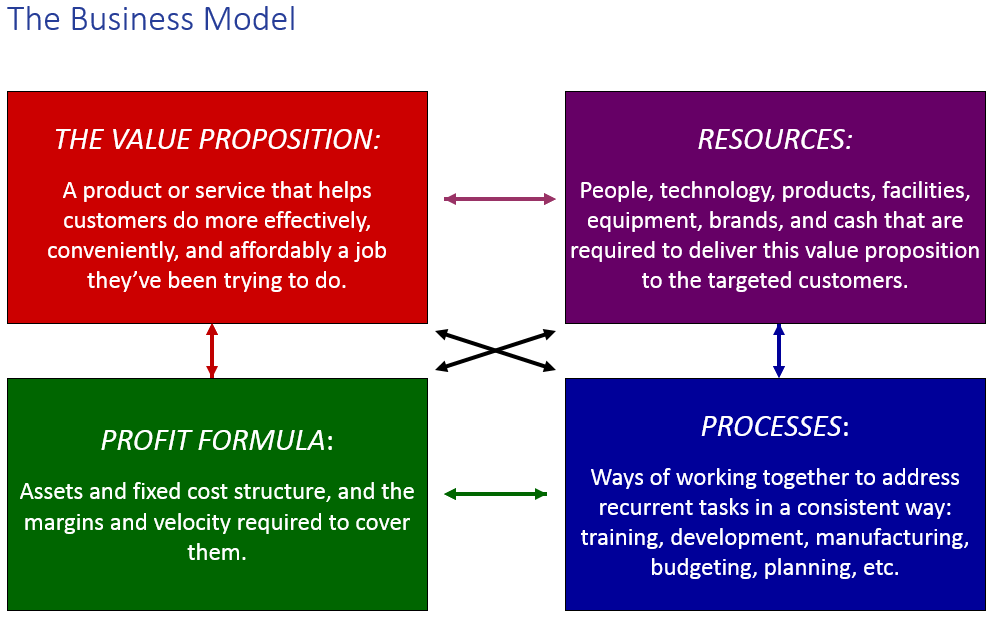
All business models begin with a value proposition, then combine resources and processes to deliver that value proposition profitably. Once profitability comes the company “locks” its business model. Business model lock-in often prevents companies from disrupting themselves because they try to use potentially disruptive technologies in sustaining ways, fitting them into their already-existing processes using their previously-arrayed resources to sustain existing profits and costs.

The parts of a business model

Nypro, a plastic molding manufacturer, saw this play out in the mid-1990s. Nypro’s value proposition centered on producing precision parts in high volumes. The CEO saw that high-volume demand was beginning to be replaced by demand for a wider variety of parts with low volume production runs. To address this emerging need, Nypro’s engineers developed a new molding machine, the Novaplast. In order to leverage existing assets, the CEO offered to lease the machine on attractive terms to his each of his plant managers.


Only nine plant managers took him up on the offer, and seven of them returned the machines after just three months.


Why did the machines fail? It wasn’t that the technology was crummy. Rather, salespeople had little reason to call on or prioritize low-volume customers when all the incentives of the sales process were aligned with turning out high-volume runs for their existing customers. Their potentially disruptive Novaplast technology got caught in a sustaining business model that was locked. Thus, the Novoplast had very little impact within the company. No one was at fault; it’s just the way that their manufacturing business model aligned.


Failure of “plug and play” EHRs

EHRs are following the same trajectory as the Novaplast machine. Health leaders see their disruptive potential. Yet most record systems are implemented as sustaining “plug and play” replacements for paper records, just as the Novaplast was implemented as a direct replacement for Nypro’s other molding machines. Clinicians using EHRs have little reason to use the new electronic system differently from the old paper system, and so EHRs often neither decrease cost nor increase quality. They’re just next year’s more expensive model of paper-based patient records.

No one is at fault; it’s just the way that the hospital business model aligns.


Recommendations

Fortunately, there are ways to avoid the trap of the sustaining business model and reap the benefits of harnessing EHRs as disruptive innovation. We offer two simple recommendations.

  • EHR designers should create the systems based on the doctor’s job to be done. Many EHR systems attempt to duplicate paper records, but for many doctors, paper records still cost less and are much more convenient than electronic versions. EHRs often do not conveniently provide the necessary patient information at every point in the care process. EHR designers need to think beyond fulfilling legal requirements and providing the same capabilities of a paper system to providing new and better organization, analysis, and information accessibility benefits that fit doctors’ true needs.

  • EHR users must think beyond merely replacing their old record systems. By investing substantial amounts of financial and human capital in systems that do little more than replace paper records and bring in incentive money from the government, health care providers are setting themselves up for eventual failure. They will never see the promised benefits because the surrounding business model has not changed. Instead, EHR-using practices need to create teams with the authority to implement systems that use EHRs to replace not just paper-based record systems but also patient check-in, insurance processing, and all other information-limited processes. Companies such as Phreesea demonstrate how electronic records in disruptive business models could make many health care jobs simpler, lower cost, and higher quality. CVS MinuteClinic uses electronic records to not just record data, but also to guide practitioners through exams and automate peer-to-peer chart review. Facilitated networks could utilize EHRs based around patient's needs. This type of innovation completely re-imagines the health care business model in a way that enables EHRs to keep their cost-cutting, effectiveness-increasing promises.

It is embarrassing as a society knowing that new technology is coming out every day that can make the world a better and more efficient place… and we let greed and desire get in the way of progress. EHR’s are so necessary to the health and criminal justice industry. People need to have open hearts and open minds about new technology and what it can do for the future, both positive and negative. In addition, we need strategies for implementing and training people to use the new technology. Eliminate old power structures and fly by information dissemination schemes, and our society can maybe continue our long journey away from imperfection. 

Some insight as to barriers for disruptive EHRs

1. One of the facets of the Accountable Care Act (ObamaCare), is the development of Accountable Carr Organizations (ACOs). These are large collections of health care services meant to save costs by “coordinating care” and this recieve incentive payments via “shared savings.” Pilot data is mixed about success, but the result is the expansion and conglomeration of large health care institutions. The result of this is the buying up of thousands of small independent medical practices to become employed physicians. Those small independent practices that were previously using small (potentially) disruptive EHR providers (see DrChrono or Practice Fusion) are now forced to abandon those systems to use the hospital/health care system’s Enterprise class EHR such as Epic or Cerner. These large EHR systems are increadibly expensive, hostile to end users needs, and have no ability to coordinate care or save costs. This type of consolidation will destroy small startups and entrench established players like Epic.

2. The Job to be done for the current crop of EHRs is not to improve care or user experience. The job to be done is to maximize revenue collected by catering to an archaic payment system of fee for service and E&M/CPT coding, hijacked by the draconian American Medical Association. Do more, document more, code more, and bill more are the incentives in this current payment system in US healthcare. Quality of care payments are talked about, but very hard to implement. Without a change to the billing and payment structure, the documentation and coding burden still exists, and the EHR will never advance beyond the paper chart.

by Ben Wanamaker and Devin Bean August 8, 2013


Additional Comments 

The one area in which EHR disruption can flourish would be in Direct Care practices (see Atlas MD), as third party insurance is not accepted, eliminating the need for huge chunks of mundane documentation and opening the door for new interaction models ( texting, web visits, telegraph, data portability, etc.

The history of innovation is littered with companies that had a potentially disruptive technology such as EHRs within their grasp but failed to commercialize it successfully because they did not couple it with a disruptive business model.”


This federal government (and its federal advisory committees) controls both the HITECH program (the part of the stimulus that provides incentives for adoption and “meaningful use” of certified EHRs) and the roughly half of healthcare spending in this country.


From the start, the timing, structure and incentives for the HITECH program have been misaligned with the new coordinated, patient-centered and accountable care models encouraged by health reform. In other words, the functions required of EHR vendors to be certified, the actions that providers need to take to receive EHR incentive payments and the success metrics of the program (i.e. adoption) are different than those required to support these new models of care.


EHR technology might not all be “bad” but much of it is not good. HITECH drove the rapid adoption of whatever was on the market: primarily the same warmed-over ’90′s technology that very few providers would invest their own money in prior to the program. The program focused EHR vendor resources on adding new, HITECH-specific functions to legacy platforms, often of functions desired by actual customers. And usability and quality of development is spotty at best with a recent survey finding that “92% of practices currently describe their current EHR as “clunky” and/or “difficult to use.” (http://www.prweb.com/releases/2013/7/prweb10926499.htm). Reduced fee-for-service productivity is an expectation and we might as well be in 1992 with regard to interoperability and data exchange between systems.


On the contrary the recommendation that EHR designers create systems based on the job to be done is a few years too late. Especially in health systems, yesterday’s systems have all been bought and the money has all been spent. Switching costs are extremely high and hospital administrators are loathe to risk purchasing systems from new market entrants. Perhaps the taxpayers and Congress will be happy to drop another couple dozen billion dollars to buy better EHR systems in the future, but in the meantime I fear that what we have is what we’re going to have, incremental improvements and lipstick-on-a-pig usability improvements aside.


It is the business model of healthcare that limits the development and implementation of innovative technologies. However I would counter that if a EHR were developed that actually mimicked a paper chart it would be widely adopted. Clinicians like paper because it is: easy to use, accessible, mobile, task-based, workflow-based, and logically organized. You can hardly say the same for most enterprise-wide EHR systems.


EHR designs can trace their lineage not from paper T-Sheets, but from billing systems, so they can ultimately support billing. HITECH and ACO’s only reinforce these systems because the business model has not changed. To the point of the authors, the ACO is sustaining innovation on the same business model of healthcare that has existed since WWII.

The one great change to the current business model of healthcare that would open up the truly “meaningful use” of technology would be the elimination of employer based health insurance. This would immediately shift the focus to the person as an individual, incentivize the user of PHR’s, force interoperability standards on vendors (similar to an ATM card working at any bank), and open the gates to real innovation in healthcare because the business model would be turned on its head the the technology would follow.


More issues:

1. The primary purpose of clinical records is communication among caregivers from past to present and present to future in order to avoid errors caused by human memory failure. Everything else is important and useful, but secondary to clinical communication over time.

2. To communicate, paper records weren’t the best choice. They were the only choice. Thus, paper records should not be used as the model for EHR. However, they are what we all learned, use and know. That cannot be ignored.

3. Psychology has shown the advantages and limitations of human attention and memory. EHR must be designed around those perceptual and cognitive factors.

4. The underlying healthcare “business model” problem is that providers own the patient’s record. And there are hundreds of thousands of individual provider – not patient – records.


Disruptive innovation is hard when conformity is legislated or worse lobbied into legislation by highly educated, very corrupt people with lot to gain from the faulty US system of reimbursement. EMRS have failed to serve their intended purpose- PAYMENT DENIAL MANAGEMENT. The biggest beast in the room is the third party administration of payments that shields the consumer( patient) and the medical-industrial complex from negotiating rates directly and paying fair value for services.Without tackling this fundamental problem we can see no meaningful process improvement. The only process improvement we will see is changes to maximize collections.

Why should an employer bear any part of an employee’s cost of healthcare? If they still want to do it, don’t pass that charge to taxpayers( reduced taxation for employer). Why is it a significant part of medical establishment ( I would say upwards of 70%) is geared toward billing and collection and not taking care of sick people? Why do we have the ostensible” NOT FOR PROFIT” moniker for hospitals that are sapping up taxpayer money and wasting them on useless things like bad EMRs, bloated administrative staff,making RNs into clipboard staff to unleash these horrors on other employees who just want to do their work and go home?

CMS may have belatedly realized the follies of paying AMA for CPT codes. This upcoming rule ( http://www.hcpro.com/HIM-295281-859/Tip-CMS-proposal-could-change-EM-dramatically.html ) may end the rush of hospitals taking over physician practices. A sort of creative disruption but delivered with a machete. It will also kill a lot of decent physicians, a profession now hard to train properly ( because the most seasoned teachers and practitioners have walked out of the profession already) . The really ill people need real doctors. 


As a stand alone solution, replacing paper is not enough of a value proposition. The value is created when an EHR actually supports a better business outcome, which can occur in multiple ways. Patient portals, and patient access to their own medical records will be integral for a medical practice to survive and compete in the future. Excellent patient communication will also be critical. In addtion, facilitating well organized patient records, with the ability to sort a patient record in multiple ways adds value to patient care as well. E-prescribing, secure doctor to doctor messaging and remote access to patient records can add substantial value to the patient care proposition. Unfortunately, the EHR world is filled with false promises and marketing noise. We have an EHR solution that not only mimics patient charting, is completely flexible and “low-tech”, but also provides all of the unique features that can truly improve revenue, profitability, patient care and efficiency.


Thursday, April 03, 2014

Engineering Turkey’s middle class and Maslowian politics

Could it really be that in our little bourgeoisie circle of secularism, we might have overlooked Turkey’s saddening reality; that despite all the statistics Prime Minister (PM) Erdogan calls out in all his speeches about Turkey’s development under his rule and despite World Bank’s superficial classification of Turkey as an upper middle income country, could it really be that Turkey is in fact still poor? Could it really be that while we wine and dine and protest in defense of our ideals, there are people out there who have other unmet priorities such as food and shelter? Could it really be that while we continue to be polarized as a nation, pointing fingers at each other, the real enemy is not any one person but a simple idea that is exploited by one person?

In the past decade, there has been talk of an ‘emerging’ middle class in developing nations including Turkey. I suspect much of the talk was based on observations, not data. Based on Turkey’s household income data, it is difficult to argue there is a large middle class in Turkey. Only 10% of the households make above TRY75,000…that’s about USD35,000 a year net of taxes…a little less than USD3,600 a month. What can you do with USD3,600 a month? Not much if you are a household. Chances are you have three dependents; a wife and at least two kids. Rent, food, kids’ school, utility bills, phone bills and possibly a vacation to a beach resort every year with the family and the annoying in-laws. There is your average middle class life. Caveat; that was the richest 10% in Turkey.

The next wealthiest 10% makes about USD18,000 per household…that’s about USD1500 a month. You can still get by but not easily anymore. Still, when you look down, you have a lot to be grateful for.

Meet Turkey’s reality; more than 70% of the households live with less than USD1000 a month. More than 30% live with less than USD500 a month. That’s less than USD16 per day for an entire household. It gets worse; there is a trend that the poorer you are, the more kids you have (a paradox that haunts the entire world save the US)…so the less money you have per individual.  Nearly 20% of the population lives at or below Turkish Statistics Institute’s definition of poverty line.

Figure 1: Income by household groups in USD

Image

Source: Turkstat, author’s calculations, 2014.

Note: I used cost of living index to calculate 2012 purchasing power of 2002 incomes, which I believe is more accurate than inflation or GDP deflator for the purposes of this article.

The middle class illusion: one then wonders if all these economists that talk about a new middle class are wrong. Not really. There is the illusion of a middle class thanks to a modest rise in incomes but more importantly a significant increase in debt.

Beneficiaries of Turkey’s ‘impressive’ growth performance: it’s beyond doubt that incomes rose in the past decade but not equally. While household data suggests there was an inclusive rise in incomes (the poor got richer and the rich less richer), individual data suggests the reverse; the bottom 20% did not see any real rise in their incomes while the top 10% saw huge gains. From a purely economic point of view, this is normal; marginal productivity theory suggests that those who contribute most to growth should reap the benefit of their efforts through higher wages. It was the ‘educated’ crowd – the top 10% – that drove Turkey’s growth in the past decade and hence ended up with a bigger share in the pie. Majority of the population saw only modest gains in incomes; around 40% over a period of 10 years. That’s about 4% each year. Nothing to celebrate given where Turkey stands today, not enough to create a middle class.

Figure 2: Per capita disposable income

Image

Source: Turkstat, author’s calculations, 2014.

Note: In 2006, Turkstat stopped releasing per capita disposable income data. I have had to divide household income by average household size. The latter is my estimate based on city level data that might not correspond to income levels but given the sample size it should be fairly accurate.

 Figure 3: change in disposable income

Image

Source: Turkstat, author’s calculations, 2014.

Low income at home, middle class on the street: the middle class ‘feel’ in Turkey has been engineered through debt.  Massive increase in household borrowing particularly by the low income households made many Turks feel like they are middle class even though they had the wages of a low income group. Despite making minimum wage, tens of thousands of households were able to acquire nicer phones, better furniture, electronics etc…all thanks to bank loans and maxed out credit cards. Turkish banking sector acted like a financial Robin Hood; banks took in deposits from the rich (50% of deposits in Turkey are owned by 0.1% of depositors) and lent it to the poor – clearly not for altruistic purposes.  Here, I will let the figures speak for themselves.

Figure 4: household debt and interest payments

Image

Source: CBT, 2014.

Figure 5: wages vs household loans (2005 = 100)

Image

Source: Turkstat, CBT, 2014.

Figure 6: household loans by income group

Image

Source: Banking Association, 2014.

Figure 7: credit to GPD and loan to deposit ratio

Image

Source: Turkstat, BRSA, 2014.

Maslowian politics:

Abraham Maslow – a 20th century psychologist – theorized that our ultimate goal of self-actualization can only be achieved through needs. Our needs start with our physiological needs; food, water, shelter, reproduction etc. Once one attains these needs, he seeks safety; safety of resources, of employment, of health etc..then love and friendship and all else as portrayed in the pyramid.

Figure 8: Maslow’s pyramid

Image

Source: Wikipedia, 2014.

For an economist, the most striking aspect of the Maslow’s pyramid is the monetary nature of our primary needs. Maslow unconsciously assumed the social hierarchy of capitalism in coming up with his theory (for more on this please refer to an earlier post – ‘Love in a time of capitalism’ http://wp.me/p44ZHA-1a). In capitalist societies, our physiological needs as well as our security needs can be fulfilled exclusively with money except for breathing (though even clean air has become a commodity lately). Once we secure a basic level of income, the upper levels of the pyramid of need satisfaction gets detached from economics and attached to the individual’s psychology.

For the bottom two levels of the pyramid, money matters more than ideology. Those that have high risk of not being able to meet their primary needs are likely to be indifferent to ideology. While this sounds most elitist, data seems to confirm it. Of the 27 countries that have GDP per capita below USD1,000, only one is rated free by the Freedom House. Conversely, of the 39 countries that have GDP per captain above USD15,000, only one is not rated free. There is a clear trend that higher the GDP per capita, more likely it is for any country to be free. When the majority of the population live at the poverty line, they are either indifferent to politics or vote for those who only do well on the economy. For them, money is what matters…not freedom and democracy and all those other bourgeoisie inventions.

Figure 9: % countries rated Free, Partly-free or Not free vs GDP per capita

Image

Source: IMF, Freedom House, 2014.

Note: I excluded natural resource rich countries from the analysis for obvious reasons.

But after the second level of needs, money takes the back seat and ideology comes to the fore. Maslow suggests that once the security of resources is achieved, people start looking things less mundane such as love and friendship. As John and Paul will tell you, ‘money can’t buy you love’. These people are most likely to be more educated and have already secured a job (will not be involuntarily unemployed for extended periods) but have higher needs. They are also likely to be staunch believers in democracy thanks to their western style education.

Turkish politics according to Maslow: using subjective judgment, I tried to classify where people stand in the pyramid based on their incomes in Figure 9. I would claim that people that live close to poverty either do not vote or do not vote for AKP. They are largely indifferent to politics or have seen their incomes shrink while witnessing others get rich. An AKP voter is most likely to be in the bottom second level. This is almost 50% of the population in Turkey that has seen a modest rise in their income but more importantly borrowed significantly hence boosting their living standards. Finally, those in the upper levels are less likely to be AKP voters. Since these people have secured vital needs, they are likely to be more interested in ideology than economics.

Figure 10: Disposable income per capita vs population

Image

Source: Turkstat, author’s calculations, 2014.

Income inequality is a lethal political weapon. Is it not interesting that we never hear PM Erdogan speak about income inequality? For a populist politician, it is the perfect tool. Still, even though his government devised scores of economic policies, none focused on income inequality which stands at embarrassingly high levels. Even his likes (President Putin in Russia and PM Orban in Hungary) have made numerous statements about it (despite it being low in the latter).

Income inequality is AKP’s bread and butter. It masks everything. It makes Turkey look like a high middle income economy. Even though a large percentage of the population is poor, thanks to those billionaires, Turkey’s GDP per capita fits World Bank’s superficial definition of an upper middle income country (what an efficient way to use world’s most brilliant economists). More importantly, income inequality is what keeps that 40-50% bound to AKP. Having seen their incomes grow and seen what the top 10% can buy, AKP is their only shot at becoming like them. AKP is the way up the pyramid (to read more on this please refer to an earlier post – ‘Why do we drink?’ http://wp.me/p44ZHA-c). For these people, AKP’s infrastructure developments are more important than freedom of speech. The latter has no utility for them, the former does.

A nation of oppressed underdogs: Turkey is stuck. Political tensions that we are witnessing today are but a result of Turkey’s non-workable growth model. Reforms pushed growth higher from 2002 to 2007, external borrowing pushed growth higher from 2008-2012 but come 2013 Turkey was out of fuel. With more than a decade in power, PM Erdogan ran out of enemies to blame. Today, the middle class drunkenness is slowly turning into a dreadful hangover as banks begin to cut off on lending and interest payments are eating away an ever-increasing share of meager incomes. Turkey needs to wake up. She needs to wake up now. We need to understand why AKP is still so successful; we need to stop marginalizing AKP’s voter base and treating them like traitors for their understandable trade-off between hard infrastructure and freedom. We need to understand that through income and opportunity inequality, AKP is feeding an illusion of middle class to people, hence buying out their votes.

To do all this, the liberals need to first stop acting the like oppressed underdogs, a political strategy invented by PM Erdogan and that plagues a whole nation. It seems, in Turkey, everyone is an underdog; the liberals, the Gulenists, the Erdoganists. We all want to get rid of our respective oppressors but do not want to move a finger for it. We think our duty to the nation is fulfilled if we protest virtually. Yes, we sometimes go out to the streets and protest but how many of us tried to hear an AKP voter out? How many of us organized public discussion sessions between opposing political views? As Erdogan tries to polarize a whole nation for his personal ambitions, we must stand together against it, not fall victim to it. Only then can we claim victory.

Friday, March 14, 2014

Türk bilim insanlarının geliştirdiği nanokompozit ısı yayan tekstil maddesi, insanoğlunun ısınma ihtiyacına devrimsel bir çözüm getirdi.

Patenti alınan teknolojiyle artık kumaşlar, soba işlevi görecek. Konut Türk bilim insanlarının geliştirdiği nanokompozit ısı yayan tekstil maddesi, insanoğlunun ısınma ihtiyacına devrimsel bir çözüm getirdi. Patenti alınan teknolojiyle artık kumaşlar, soba işlevi görecek. Konut ısıtmasından astronot kıyafetlerine, modadan savunma sanayine geniş bir alanda önemli değişiklikler sağlaması beklenen buluşun kullanıldığı ilk ürün ise "portatif sauna" oldu.sıtmasından astronot kıyafetlerine, modadan savunma sanayine geniş bir alanda önemli değişiklikler sağlaması beklenen buluşun kullanıldığı ilk ürün ise "portatif sauna" oldu.

Kalkınma Bakanlığı desteğiyle Dokuz Eylül Üniversitesi bünyesinde kurulan ve yerli kaynaklardan yüksek katma değerli teknolojiler geliştirmeyi amaçlayan Elektronik Malzeme Üretim ve Uygulama Merkezi (EMUM), yarattığı patentlerle dikkati çekiyor. Nanoteknoloji ve kimya teknolojileri konusunda dünyada ilk kez geliştirilen çok sayıda buluş için patent alan merkez, ısı yayan nanokompozit film ve tekstil maddeleri geliştirilmesi projesiyle ısınma teknolojisinde devrimsel bir buluşa imza attı.

MUM Müdürü Prof. Dr. Erdal Çelik ve DEÜ Metalurji ve Malzeme Mühendisliği Bölümü Araştırma Görevlisi Dr. Mustafa Erol`un 2007`de başladıkları ısı yayan nanokompozit malzeme geliştirmesi projesiyle portatif sauna, konut ve seralar için yerden ısıtma sistemi, kombiler için su ısıtma sistemi, ısı yayan halı ve battaniye gibi ürünler geliştirildi. Isı yayan tekstil malzemesiyle ilgili açıklama yapan Prof. Dr. Çelik, dünyada sayılı bulunan gelişmiş cihazlara sahip merkezde günlük hayata uygulanabilecek nanoteknoloji projeleri üzerinde çalıştıklarını, metrenin milyarda biri büyüklüğündeki ölçeklerde çalışarak hayatı kolaylaştıracak işlevsel malzemeler geliştirmeyi hedeflediklerini söyledi.


Nanoteknolojik müdahaleyle ısı yayan malzemeler geliştirme fikri üzerinde yürüttükleri tartışmalar sırasında nihai ürün olarak portatif bir sauna üretip üretemeyeceklerini görmek üzere proje geliştirdiklerini anlatan Çelik, Bilim, Sanayi ve Teknoloji Bakanlığı`nın San-Tez Programı kapsamında desteklediği projeyle demir çelik sektöründe metallerin eritildiği kazanlarda kullanılan bir karbon türevi olan grafit malzemesini nano boyutlara uygulamaya çalıştıklarını söyledi. 6 yıl süren çalışma kapsamında öğüterek nano boyutlara indirgedikleri grafitleri, polimerler vasıtasıyla tekstil ve film malzemelerinin üzerine işlediklerini anlatan Çelik, 12 voltluk elektrikle ısı yayan malzemenin homojen bır ısınma sağladığını ifade etti.


Isı yayan tekstil ya da filmin en fazla kaç dereceye ulaşabileceğini önceden belirleyebildiklerini anlatan Çelik, geliştirdikleri malzemenin istendiği gibi kıvırılıp katlanabildiğini, esnetilebildiğini söyledi. Klasik ısıtıcılarda ısınmanın metal rezistanslar aracılığıyla yapılabildiğini, tel üzerinde çok yüksek derecede oluşan sıcaklığın ortama yayılarak ısı oluşturulduğunu, nanokompozit malzemede ise ısınmanın malzemenin tamamında homojen olarak gerçekleştiğini, bunun da klasik sisteme göre daha güvenli ve düşük maliyetli ısınma imkanı sağladığını ifade etti. "Isı teknolojilerinde devrim yaratacak bir teknoloji geliştirdik" diye konuşan Çelik, teknolojiyi kullanarak şu ana kadar portatif sauna, ısı yayan halı ve battaniye ürettiklerini anlattı.

Ürettikleri portatif saunayı halen evinde kullandığını söyleyen Çelik, şöyle konuştu: "2 metrekarelik nanokompozit filmle kapladığımız yüzeyi kıvırarak silindir bir odacık şeklindeki portatif sauna haline getirebiliyoruz. Saunanın içinde 75 derecelik bir sıcaklık oluşuyor. Nanokompozit malzemeyle ürettiğimiz diğer bir ürün de ısı yayan halı. Serili olduğu alanda ısı yayan bu malzemeyi konutların yerden ısıtmasında da kullanabiliyoruz. Malzemenin seri üretimi için firmalarla görüşme halindeyiz.

Bu ürünün günlük hayatta kullanımı ilk olarak ısı yayan halı, portatif sauna ve küçük boyutlu ısı yayan tekstil ürünleriyle başlayacak. Isı yayan battaniye ve kıyafetler üzerinde iyileştirme çalışmalarımız devam ediyor."

Dr. Mustafa Erol ise yaptığı açıklamada, ısıya ihtiyaç duyulan her alanda kullanılabilecek bu malzemenin çok ucuz hammaddelerle üretildiğini, diğer ısınma araçlarına göre daha düşük kurulum ve çalıştırma maliyetine sahip olduğunu söyledi. Laboratuvar koşullarında metrekaresi ortalama 100 liralık toplam maliyetle üretilen malzemenin seri üretime geçilmesi halinde çok daha ucuza mal edilebileceğini ifade eden Erol, konutların nanokompozit malzemeyle doğalgaza göre çok daha ucuza ısıtılabileceğini ifade etti.

Sistemin giysiler üzerinde denemelerinin devam ettiğini, astronot giysileri, askeri ve sportif kullanım için de geliştirme çalışması yapıldığını ifade eden Erol, "Bu teknoloji yakın gelecekte kış giysilerinde önemli değişiklikleri beraberinde getirecek. Örneğin pille çalışan ısı yayan tekstilden yapılmış giysiler, kışın üşüme sorununu ortadan kaldırabilecek. Sistemi farklı yönlerde geliştirme noktasında önerilere açığız. Ayrıca tasarım boyutuyla da tekstil firmalarıyla görüşüyoruz" dedi.

Türkiye`nin doğal kaynaklarının bulunmadığı ve ısınma için yüksek miktarda ithal enerji kullandığına da dikkati çeken Çelik, bu buluşun Türkiye`nin enerji faturasını da düşürebileceğini öne sürdü. -Bakan ödül vermişti Bilim Sanayi ve Teknoloji Bakanlığı`nın üniversite sanayi işbirliğini canlandırmak için yürüttüğü Sanayi Tezleri Programı tarafından desteklenen proje, geçen yıl "En İyi Sanayi Tezi Projesi" seçilmişti.

Integrating AI into Clinical Workflows

By Erdem Asma A CMIO's Strategic Assessment of Risks, Opportunities, and Implementation Imperatives for Provider Organizations   with Cl...