Showing posts with label Obamacare. Show all posts

Sunday, May 11, 2014

Why EHRs are not (yet) disruptive

In 2005, Rand Corporation projected widespread use of electronic health records (EHRs) could save the U.S. $81 billion per year in health care. Eight years later, more than 80% of hospitals use EHRs and have received incentive payments for their “meaningful use,” yet projected savings have still not materialized.  Many blamed our bloated hospitals.


We disagree. EHRs are not unsuccessful because of health care providers’ ineptness. Rather, they are a potentially disruptive technology that got caught in a legacy business model that can only prioritize sustaining innovations.


What makes an innovation “disruptive”?

Disruption does not just mean ‘idea making waves’ or ‘breakthrough technology.’ Rather, disruptive innovation theory explains how companies with cheaper, lower performing technologies target non-consumers or low-end customer segments and grow upmarket to eventually kill larger competitors with less expensive, simpler products. The personal computer, for example, disrupted the mainframe and minicomputer industry.
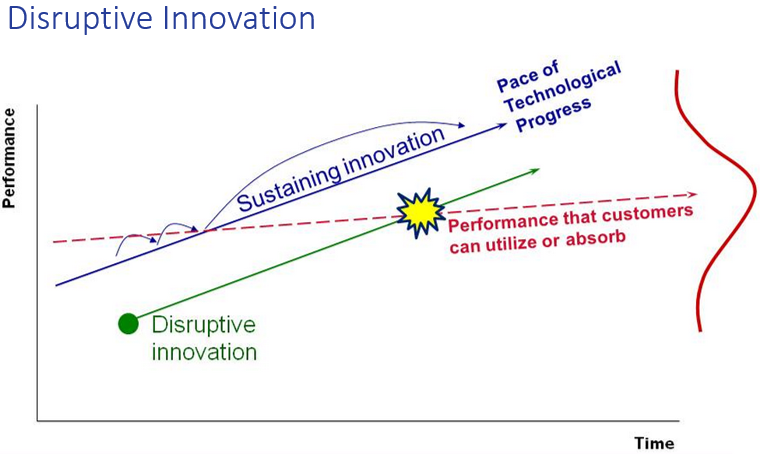
 
disruptive innovation

In contrast, a sustaining innovation targets demanding, high-end customers with better performing, more complex products. Next year’s car model is a sustaining innovation. It’s sleek, has more horsepower than most of us could ever use, and costs more than last year’s model. Sustaining innovations result in wonderful, high performing products but not lower prices.


The reason EHRs are not “roiling the healthcare landscape” with disruption is not that the technology is bad—rather it’s the business model in which they are being implemented. While there is some evidence that EHRs can help to increase healthcare quality, the technology is by and large being crammed into sustaining business models and used as an expensive sustaining innovation to replace paper records with complex electronic systems.  Implementing new technology to sustain the way you already make money almost always keeps costs high and prevents true disruption. Indeed, the history of innovation is littered with companies that had a potentially disruptive technology such as EHRs within their grasp but failed to commercialize it successfully because they did not couple it with a disruptive business model.


Business model lock-in

All business models begin with a value proposition, then combine resources and processes to deliver that value proposition profitably. Once profitability comes the company “locks” its business model. Business model lock-in often prevents companies from disrupting themselves because they try to use potentially disruptive technologies in sustaining ways, fitting them into their already-existing processes using their previously-arrayed resources to sustain existing profits and costs.
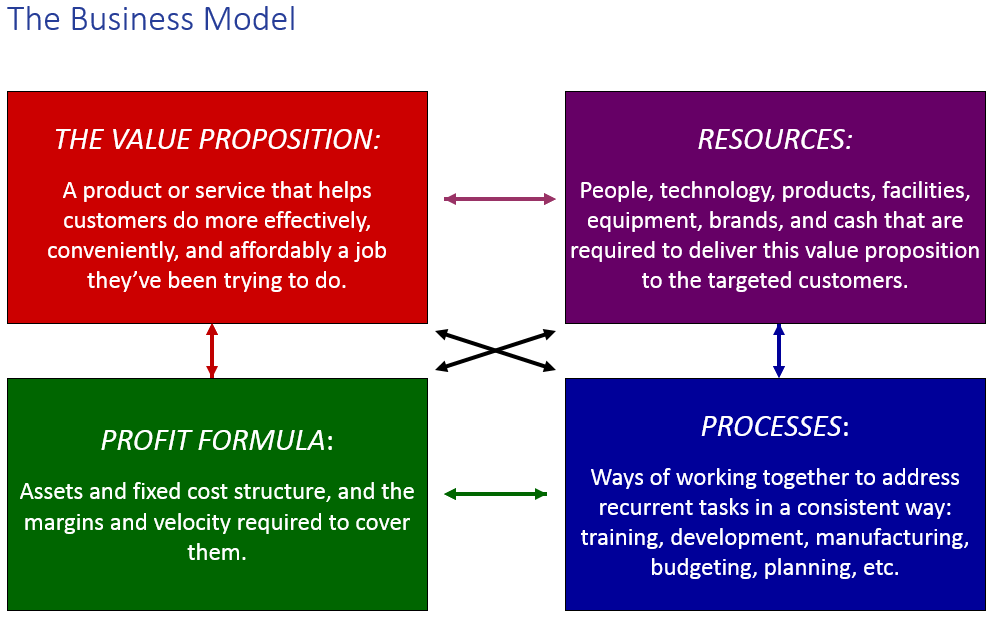
The parts of a business model

Nypro, a plastic molding manufacturer, saw this play out in the mid-1990s. Nypro’s value proposition centered on producing precision parts in high volumes. The CEO saw that high-volume demand was beginning to be replaced by demand for a wider variety of parts with low volume production runs. To address this emerging need, Nypro’s engineers developed a new molding machine, the Novaplast. In order to leverage existing assets, the CEO offered to lease the machine on attractive terms to his each of his plant managers.


Only nine plant managers took him up on the offer, and seven of them returned the machines after just three months.


Why did the machines fail? It wasn’t that the technology was crummy. Rather, salespeople had little reason to call on or prioritize low-volume customers when all the incentives of the sales process were aligned with turning out high-volume runs for their existing customers. Their potentially disruptive Novaplast technology got caught in a sustaining business model that was locked. Thus, the Novoplast had very little impact within the company. No one was at fault; it’s just the way that their manufacturing business model aligned.


Failure of “plug and play” EHRs

EHRs are following the same trajectory as the Novaplast machine. Health leaders see their disruptive potential. Yet most record systems are implemented as sustaining “plug and play” replacements for paper records, just as the Novaplast was implemented as a direct replacement for Nypro’s other molding machines. Clinicians using EHRs have little reason to use the new electronic system differently from the old paper system, and so EHRs often neither decrease cost nor increase quality. They’re just next year’s more expensive model of paper-based patient records.

No one is at fault; it’s just the way that the hospital business model aligns.


Recommendations

Fortunately, there are ways to avoid the trap of the sustaining business model and reap the benefits of harnessing EHRs as disruptive innovation. We offer two simple recommendations.

  • EHR designers should create the systems based on the doctor’s job to be done. Many EHR systems attempt to duplicate paper records, but for many doctors, paper records still cost less and are much more convenient than electronic versions. EHRs often do not conveniently provide the necessary patient information at every point in the care process. EHR designers need to think beyond fulfilling legal requirements and providing the same capabilities of a paper system to providing new and better organization, analysis, and information accessibility benefits that fit doctors’ true needs.

  • EHR users must think beyond merely replacing their old record systems. By investing substantial amounts of financial and human capital in systems that do little more than replace paper records and bring in incentive money from the government, health care providers are setting themselves up for eventual failure. They will never see the promised benefits because the surrounding business model has not changed. Instead, EHR-using practices need to create teams with the authority to implement systems that use EHRs to replace not just paper-based record systems but also patient check-in, insurance processing, and all other information-limited processes. Companies such as Phreesea demonstrate how electronic records in disruptive business models could make many health care jobs simpler, lower cost, and higher quality. CVS MinuteClinic uses electronic records to not just record data, but also to guide practitioners through exams and automate peer-to-peer chart review. Facilitated networks could utilize EHRs based around patient's needs. This type of innovation completely re-imagines the health care business model in a way that enables EHRs to keep their cost-cutting, effectiveness-increasing promises.

It is embarrassing as a society knowing that new technology is coming out every day that can make the world a better and more efficient place… and we let greed and desire get in the way of progress. EHR’s are so necessary to the health and criminal justice industry. People need to have open hearts and open minds about new technology and what it can do for the future, both positive and negative. In addition, we need strategies for implementing and training people to use the new technology. Eliminate old power structures and fly by information dissemination schemes, and our society can maybe continue our long journey away from imperfection. 

Some insight as to barriers for disruptive EHRs

1. One of the facets of the Accountable Care Act (ObamaCare), is the development of Accountable Carr Organizations (ACOs). These are large collections of health care services meant to save costs by “coordinating care” and this recieve incentive payments via “shared savings.” Pilot data is mixed about success, but the result is the expansion and conglomeration of large health care institutions. The result of this is the buying up of thousands of small independent medical practices to become employed physicians. Those small independent practices that were previously using small (potentially) disruptive EHR providers (see DrChrono or Practice Fusion) are now forced to abandon those systems to use the hospital/health care system’s Enterprise class EHR such as Epic or Cerner. These large EHR systems are increadibly expensive, hostile to end users needs, and have no ability to coordinate care or save costs. This type of consolidation will destroy small startups and entrench established players like Epic.

2. The Job to be done for the current crop of EHRs is not to improve care or user experience. The job to be done is to maximize revenue collected by catering to an archaic payment system of fee for service and E&M/CPT coding, hijacked by the draconian American Medical Association. Do more, document more, code more, and bill more are the incentives in this current payment system in US healthcare. Quality of care payments are talked about, but very hard to implement. Without a change to the billing and payment structure, the documentation and coding burden still exists, and the EHR will never advance beyond the paper chart.

by Ben Wanamaker and Devin Bean August 8, 2013


Additional Comments 

The one area in which EHR disruption can flourish would be in Direct Care practices (see Atlas MD), as third party insurance is not accepted, eliminating the need for huge chunks of mundane documentation and opening the door for new interaction models ( texting, web visits, telegraph, data portability, etc.

The history of innovation is littered with companies that had a potentially disruptive technology such as EHRs within their grasp but failed to commercialize it successfully because they did not couple it with a disruptive business model.”


This federal government (and its federal advisory committees) controls both the HITECH program (the part of the stimulus that provides incentives for adoption and “meaningful use” of certified EHRs) and the roughly half of healthcare spending in this country.


From the start, the timing, structure and incentives for the HITECH program have been misaligned with the new coordinated, patient-centered and accountable care models encouraged by health reform. In other words, the functions required of EHR vendors to be certified, the actions that providers need to take to receive EHR incentive payments and the success metrics of the program (i.e. adoption) are different than those required to support these new models of care.


EHR technology might not all be “bad” but much of it is not good. HITECH drove the rapid adoption of whatever was on the market: primarily the same warmed-over ’90′s technology that very few providers would invest their own money in prior to the program. The program focused EHR vendor resources on adding new, HITECH-specific functions to legacy platforms, often of functions desired by actual customers. And usability and quality of development is spotty at best with a recent survey finding that “92% of practices currently describe their current EHR as “clunky” and/or “difficult to use.” (http://www.prweb.com/releases/2013/7/prweb10926499.htm). Reduced fee-for-service productivity is an expectation and we might as well be in 1992 with regard to interoperability and data exchange between systems.


On the contrary the recommendation that EHR designers create systems based on the job to be done is a few years too late. Especially in health systems, yesterday’s systems have all been bought and the money has all been spent. Switching costs are extremely high and hospital administrators are loathe to risk purchasing systems from new market entrants. Perhaps the taxpayers and Congress will be happy to drop another couple dozen billion dollars to buy better EHR systems in the future, but in the meantime I fear that what we have is what we’re going to have, incremental improvements and lipstick-on-a-pig usability improvements aside.


It is the business model of healthcare that limits the development and implementation of innovative technologies. However I would counter that if a EHR were developed that actually mimicked a paper chart it would be widely adopted. Clinicians like paper because it is: easy to use, accessible, mobile, task-based, workflow-based, and logically organized. You can hardly say the same for most enterprise-wide EHR systems.


EHR designs can trace their lineage not from paper T-Sheets, but from billing systems, so they can ultimately support billing. HITECH and ACO’s only reinforce these systems because the business model has not changed. To the point of the authors, the ACO is sustaining innovation on the same business model of healthcare that has existed since WWII.

The one great change to the current business model of healthcare that would open up the truly “meaningful use” of technology would be the elimination of employer based health insurance. This would immediately shift the focus to the person as an individual, incentivize the user of PHR’s, force interoperability standards on vendors (similar to an ATM card working at any bank), and open the gates to real innovation in healthcare because the business model would be turned on its head the the technology would follow.


More issues:

1. The primary purpose of clinical records is communication among caregivers from past to present and present to future in order to avoid errors caused by human memory failure. Everything else is important and useful, but secondary to clinical communication over time.

2. To communicate, paper records weren’t the best choice. They were the only choice. Thus, paper records should not be used as the model for EHR. However, they are what we all learned, use and know. That cannot be ignored.

3. Psychology has shown the advantages and limitations of human attention and memory. EHR must be designed around those perceptual and cognitive factors.

4. The underlying healthcare “business model” problem is that providers own the patient’s record. And there are hundreds of thousands of individual provider – not patient – records.


Disruptive innovation is hard when conformity is legislated or worse lobbied into legislation by highly educated, very corrupt people with lot to gain from the faulty US system of reimbursement. EMRS have failed to serve their intended purpose- PAYMENT DENIAL MANAGEMENT. The biggest beast in the room is the third party administration of payments that shields the consumer( patient) and the medical-industrial complex from negotiating rates directly and paying fair value for services.Without tackling this fundamental problem we can see no meaningful process improvement. The only process improvement we will see is changes to maximize collections.

Why should an employer bear any part of an employee’s cost of healthcare? If they still want to do it, don’t pass that charge to taxpayers( reduced taxation for employer). Why is it a significant part of medical establishment ( I would say upwards of 70%) is geared toward billing and collection and not taking care of sick people? Why do we have the ostensible” NOT FOR PROFIT” moniker for hospitals that are sapping up taxpayer money and wasting them on useless things like bad EMRs, bloated administrative staff,making RNs into clipboard staff to unleash these horrors on other employees who just want to do their work and go home?

CMS may have belatedly realized the follies of paying AMA for CPT codes. This upcoming rule ( http://www.hcpro.com/HIM-295281-859/Tip-CMS-proposal-could-change-EM-dramatically.html ) may end the rush of hospitals taking over physician practices. A sort of creative disruption but delivered with a machete. It will also kill a lot of decent physicians, a profession now hard to train properly ( because the most seasoned teachers and practitioners have walked out of the profession already) . The really ill people need real doctors. 


As a stand alone solution, replacing paper is not enough of a value proposition. The value is created when an EHR actually supports a better business outcome, which can occur in multiple ways. Patient portals, and patient access to their own medical records will be integral for a medical practice to survive and compete in the future. Excellent patient communication will also be critical. In addtion, facilitating well organized patient records, with the ability to sort a patient record in multiple ways adds value to patient care as well. E-prescribing, secure doctor to doctor messaging and remote access to patient records can add substantial value to the patient care proposition. Unfortunately, the EHR world is filled with false promises and marketing noise. We have an EHR solution that not only mimics patient charting, is completely flexible and “low-tech”, but also provides all of the unique features that can truly improve revenue, profitability, patient care and efficiency.


Monday, September 30, 2013

Everything you need to know about life under Obamacare By Ezra Klein and Sarah Kliff, Published: September 30 at 12:14 pm

1. What is Obamacare?

It's more than just a bumper sticker. (REUTERS/Jessica Rinaldi)

It's more than just a bumper sticker. (Reuters/Jessica Rinaldi)

“Obamacare” is what we’ve all apparently decided to call the Patient Protection and Affordable Care Act, a set of health reforms passed by the Congress and signed into law by President Obama in March 2010.

The law itself touches on everything from how hospitals are reimbursed for care to whether chain restaurants post calorie counts on their menus. But, generally, by "Obamacare" most people mean the provisions of the law that relate to the efforts to insure about 30 million Americans through subsidized private insurance or government-provided Medicaid.

2. When is Obamacare?

Soon! Obamacare’s insurance marketplaces -- where people who don't get health insurance through Medicaid, Medicare or their employer will go to buy it -- begin open enrollment on Tuesday (Oct. 1). The law actually begins delivering insurance coverage, both through private plans bought on the marketplaces and through Medicaid, on Jan. 1.

3. Are you sure it will really start then?

Pretty sure. There have been some small delays in the functionality of different marketplaces. In the D.C. marketplace, for instance, consumers won’t be able to see their subsidies until November. In the federally-run marketplaces, small businesseswon’t be able to shop online until November. But overall, the law looks on track for New Year's Day.

4. Will Obamacare be available in every state?

Some of it will, some of it won’t. The insurance marketplaces, and the subsidies that go along with them, will be available in every state and the District of Columbia. But the Medicaid expansion, which serves people making less than 133 percent of the federal poverty line ($31,322 for a family of four), was made optional by the Supreme Court. As of now, only 26 states are likely to participate in it come January.

What makes this particularly troublesome for the law (and, more to the point, for the uninsured) is that there are no subsidies for private insurance for people making less than the poverty line. So if you’re poor and in a state that hasn’t accepted the Medicaid expansion, you’re out of luck.

5. Who gets insurance through the program?

health coverage sources

Here's the biggest thing to know about Obamacare: Most people will never notice it.

If you get health insurance through your employer or the government -- as 80 percent of Americans do -- it's very unlikely that you'll interact with Obamacare's coverage expansion at all. (There are other provisions in Obamacare, like some of the efforts to improve care quality or cut health-care costs, that could affect you. But that's not the core of the law or the part that's starting Tuesday.)

Obamacare mostly matters most for the 20 percent of Americans who are either uninsured or get insurance on the individual (or "non-group") market. Anyone in those groups can get insurance through Obamacare. Those who make more than the federal poverty line, but less than four times the poverty line ($94,200 for a family of four), can buy subsidized insurance on the marketplaces. Those making less than 133 percent of the poverty line, and living in a state that has accepted the Medicaid expansion, can get Medicaid.

The Congressional Budget Office expects that the Affordable Care Act will cover about 14 million of the uninsured in 2014 and 25 million by the end of the decade. That still leaves about 30 million people uninsured. More on them here.

6. If I already have health insurance, do I have to care about this?

Probably not. The truth of Obamacare is that it mostly affects the uninsured and people who don’t have employer-based or government-based health insurance. That’s a relatively small fraction of the population, even though we often talk about the law as if it affects everyone.

7. Are there death panels? 

No.

8. But I wanted death panels. 

Thanos wants death panels.

Thanos wants death panels.

Sorry.

9. How much are the premiums?

That will vary depending on the state you’re in, your age, your health, your income, the kind of plan you want, etc. The fastest way to figure out your costs is to go towww.HealthCare.gov.

10. What does it cover?

All insurance under Obamacare has to cover a set of health benefits the Obama administration has defined as “essential.” They are “ambulatory patient services; emergency services; hospitalization; maternity and newborn care; mental health and substance use disorder services, including behavioral health treatment; prescription drugs; rehabilitative and habilitative services and devices; laboratory services; preventive and wellness services and chronic disease management; and pediatric services, including oral and vision care.”

The bottom line is that if you get sick, the insurance you get through Obamacare is almost certainly going to cover you.

11. How much will I pay out of pocket?

Depends. Out-of-pockets costs in Medicaid are almost nothing. In the insurance marketplaces, however, there are four levels of insurance coverage: Bronze, silver, gold and platinum. These levels correspond to the amount of health costs they’ll cover for the average applicant: 60 percent for bronze, 70 percent for silver, 80 percent for gold, 90 percent for platinum (there’s also a bare-bones “catastrophic" option available to applicants under age 30). The lower your level of coverage, the more you’ll pay out of pocket.

But the law also has secondary out-of-pocket protections, including limits on out-of-pocket costs for lower-income families. The Kaiser Family Foundation's subsidy calculator will tell you if you qualify.

12. How many options will I have to choose from?

Since both Medicaid and the insurance marketplaces are different in different states, it depends on where you live. Entering your information at HealthCare.gov will give you the quickest overview.

13. What if I have a preexisting condition?

Under Obamacare, it doesn’t matter. One of the really big changes that the health law makes to the insurance marketplaces is eliminating the relevance of preexisting conditions altogether. This is true for both plans sold on the new marketplaces, and those sold outside of it. This means that insurers won’t be allowed to ask you about your health, or charge you more because of it.

14. What if I’m young and really, really healthy?

Congratulations! You’re in the prime of your life – and may have heard that you’re getting ripped off by the health care law. Here’s the deal: The health care law limited the amount that insurers can charge really old people, and that might lead them to bump up the rates for younger people. A lot of this will depend on where you live.

This chart from the Kaiser Family Foundation, which shows the premiums for a 25-year-old who earns $25,000, might help you out:

25 year old

15. How much information will I have to share with the government?

You’ll have to tell them some basics: name, age, address, income and the size of your family. You will have to tell whether you use tobacco (the law includes a premium surcharge for smokers). You won’t have to share information about your health status or doctor.

[16. If I lie about smoking, can they catch me? -- Dylan (I'm actually curious about this one!)]

16. Where do I go to buy it?

www.HealthCare.gov.

17. Who can help me buy health insurance?

If you don’t want to just sign up on your own, there are people who can help guide you through the process. You could go to the insurance brokers who sell health plans right now, typically receiving a commission for their work. The health care law funds some new positions to provide similar help. Dubbed “navigators,” these are people whose whole job is to explain the enrollment process. They do not receive a commission from the health plan for enrolling someone in coverage.

18. How hard will it be to sign up?

Maygan Rollins, 22, a field organizer with EnrollAmerica, holds a clipboard with pamplets while canvassing at a bus stop, Wednesday, Sept. 25, 2013, in Miami. EnrollAmerica is a private, non-profit organization running a grassroots campaign to encourage people to sign up for health care offered by the Affordable Care Act. In less than a week Florida residents can start enrolling for health coverage under the Affordable Care Act. (AP Photo/Lynne Sladky)

Maygan Rollins, a field organizer with EnrollAmerica, canvasses in Miami. (AP Photo/Lynne Sladky)

That’s a little difficult to predict right now. What we do know is that anyone who wants to buy coverage will have to enter in basic information: Their age, income, state of residence and family size. After that, if all goes as planned, shoppers will be able to compare different health plans.

Federal officials have found that, in the very best case scenario, people will be able to buy coverage in just seven minutes. That’s probably not the typical case, where someone will want to take time going over plan options. And there’s also the possibility of glitches with information processing that could delay the process.

19. How long do I have to sign up?

Finally, a simple question! You can buy health coverage on the marketplaces from Oct. 1 to March 31. After that open enrollment period, you’re out of luck for buying a plan in 2014. There are exceptions made for people who experience a life-changing circumstance, such as moving to a new state or losing a job.

20. What if I don’t want to buy insurance? 

First off: Nobody will come knocking down your door, demanding that you purchase a health plan. But if you decide not to purchase coverage, you will have to pay a $95 tax penalty. This would be deducted from your 2015 tax return.

21. How will the government know if I have health insurance?

You’ll have to tell them, via the taxes that you file for 2014. Starting then, the Internal Revenue Service will send out a form where you’ll fill in the type of health plan you purchased (or, if you didn’t purchase coverage, noting that fact). Employers might hand out pre-populated versions of these forms to make things a little bit easier.

22. Will the government send gunmen to track me down if I’m not insured?

Creepy Uncle Sam will not come find you if you don't have health insurance (YouTube)

Creepy Uncle Sam will not come find you if you don't have health insurance. (YouTube)

While this is a popular Obamacare myth, it is, in fact, untrue: The federal government is actually really limited in the action it can take to collect the tax penalty for not purchasing health coverage. It can’t send agents to your door, nor can it put a lien on your house. The most they can do is take the fine out of your tax refund – or, if you’re not getting a refund this year, put it on your tab for next year’s refund.

23. What if I can’t find an affordable plan? Do I still have to buy something?

Nope! Although it’s the government, not you, who gets to decide what counts as “affordable.” The health care law says that if you can’t find a plan that costs less than 8 percent of your income, then you’re exempt from the requirement to purchase health insurance. This will, obviously, depend a lot on an individual’s circumstances and not the sticker price of the plans sold on the new marketplaces.

24. What if I don’t want to buy insurance yet, but think I might want to buy it later?

Open enrollment lasts until March 31, so you have until then to weigh your options. After that, you can’t buy insurance until next open enrollment period, which starts on Oct. 7, 2014.

25. What if I get insurance through Obamacare and then I get a job that pays more money?

Well, go out and have a celebratory drink! And then celebrate more by...filling out some paperwork! If your income changes, you’re supposed to go back online and report that shift. Any federal help you get purchasing health insurance coverage will likely be adjusted to reflect your new income. The other option here is not to report your new income, although the government will figure it out when you file taxes the next year – and then look to recoup the tax credits you were not supposed to receive.

26. Was the individual mandate delayed?

It was not. While the White House did delay the requirement that large employers offer coverage to their workers, it did not touch the provision that says all individuals must carry health insurance coverage. That still takes effect on Jan. 1.

27. I own a small business. What does this mean for me?

A few things, starting with the new small business health insurance marketplaces. These are new online marketplaces that open Oct. 1, where you could help your workers buy insurance coverage. Initially, the idea for these marketplaces was to have employers chip in a certain amount and then their employees could pick any health insurance plan they wanted; a young worker might want cheaper premiums, whereas someone older could purchase more robust coverage.

The federal government had to delay that functionality for one year, though, because of technical problems. That means, in 2014, you will pick one plan for your workers to enroll in. Some states running their own marketplaces, however, will allow for full employee choice of any plans starting Tuesday.

28. How are the subsidies paid for? Are my taxes going up? 

There are essentially two big funding streams for the Affordable Care Act. The first are cuts to Medicare reimbursements. We heard a lot about this during the presidential campaign, when Mitt Romney would talk about the law cutting $716 billion from Medicare. These are cuts largely to the rates that we pay doctors who see Medicare patients, and also what we pay private insurers that cover these subscribers.

The other big funding source are taxes on different health care industries like hospitals, insurance companies and, more relevant in recent days, medical device makers. There's a debate about whether those taxes will get passed on to consumers, but, as it stands, they're not direct taxes on you as an individual.

There is one tax that is applied to some individuals, which began last year: The Affordable Care Act raised taxes on investment income for people who earn more than $200,000.

29. I hear that there are long waiting lists in countries with laws like Obamacare. Am I going to have to wait longer for surgeries?

The United States does right now have some of the shortest wait times in the world to see speciality doctors. We tend to have shorter wait times than a few countries with national health care systems, like Canada and the United Kingdom.

We're expanding our health care system to cover millions more people, making it a little more like a national health care system. When we hand out all those insurance cards, will people still be able to see their doctor?

We don't know for sure what will happen, but we do have a few historical examples to look at, like when Medicare launched in 1965, and the New York Times ran this cartoon to illustrate the looming influx of patients:

The long wait times never really materialized in any serious way. "At the end of its third week," the New York Times reported a few months later, "the Medicare program was reported going smoothly, with difficulties in some areas of the South still the only major problem."

In Massachusetts, wait times to see specialists were bad before the state passed a universal coverage law, and bad afterwards. You can read more on that from Jonathan Cohn.

30. I'm 25 and uninsured, but my folks have insurance. What does the law do for me?

For you, Obamacare might be the best deal: The health law allows young adults up to age 26 to stay on their parents' health insurance plan. About 3 million people have taken up this option so far. So start bugging your mom to fill out the paperwork.

31. Where can I go for more information?

After Oct. 1, the best way to learn about what Obamacare does and doesn't mean for you is to go to www.HealthCare.Gov and tool around. Meanwhile, the Kaiser Family Foundation's subsidy calculator is your best bet. For more of an overview of the law, the Kaiser Family Foundation's summary is excellent.

(Photo by Jonathan Alcorn/Reuters)

(Photo by Jonathan Alcorn/Reuters)

Obamacare's open questions. "While some people desperate for coverage will need no persuading to sign up, for others the decision will amount to a series of complicated calculations that would challenge an accounting whiz, let alone an ordinary human: Are the new plans less expensive or more generous than existing ones? How do premiums and out-of-pocket costs compare? Are the networks of doctors and hospitals the most desirable? Who qualifies for how much of a subsidy, and what is the tax penalty for a miscalculation?" Katie Thomas and Reed Abelson in The New York Times.

What polls show about Obamacare. "A day before the new health care exchanges open across the country, a new report shows that the more people understand it, the more they’re inclined to participate. But while most people are aware of the law’s requirement to buy insurance or face a penalty, a much smaller number have any understanding of the insurance exchanges opening on Tuesday or of the financial aid available to help people buy insurance. The findings, by The Commonwealth Fund, indicate that the Obama administration still has a long way to go to make the law’s complicated provisions clear to prospective buyers." The New York Times.

U.S. to unveil new insurance options. "The Obama administration plans on Monday to announce scores of new health insurance options to be offered to consumers around the country by the Blue Cross and Blue Shield Association and the United States Office of Personnel Management, the agency that arranges health benefits for federal employees, according to administration officials...The options are part of a multistate insurance program...Federal officials said they had signed a contract with the Blue Cross and Blue Shield Association to offer health insurance next year in the marketplaces, or exchanges, of 30 states and the District of Columbia." Robert Pear inThe New York Times.

Insurers balk at paying for intensive psychiatric care. "[T]he rules underlying mental health coverage in general — for both private insurers and the new health care exchanges — are still unclear, mental-health patient advocates say, leaving patients and families to grind through the process as best they can...Unlike some physical ailments for which there are reams of studies suggesting a relatively clear standard of care, there is often little accepted medical evidence to support the range of treatments for many mental illnesses, like schizophrenia and severe depression...[W]hen patients need months of residential care, for example, or meetings with a therapist several times a week, insurers balk. The insurance executives say that the medical benefits of such treatments are not clear and that the industry is essentially being asked to write a blank check." Reed Abelson in The New York Times.

Integrating AI into Clinical Workflows

By Erdem Asma A CMIO's Strategic Assessment of Risks, Opportunities, and Implementation Imperatives for Provider Organizations   with Cl...